Research across the law and your agency’s systems.

Mesa reads statutes and codes, queries your GIS layers and council records, searches your shared drives and the web, and cites every source in the answer.

See how it works
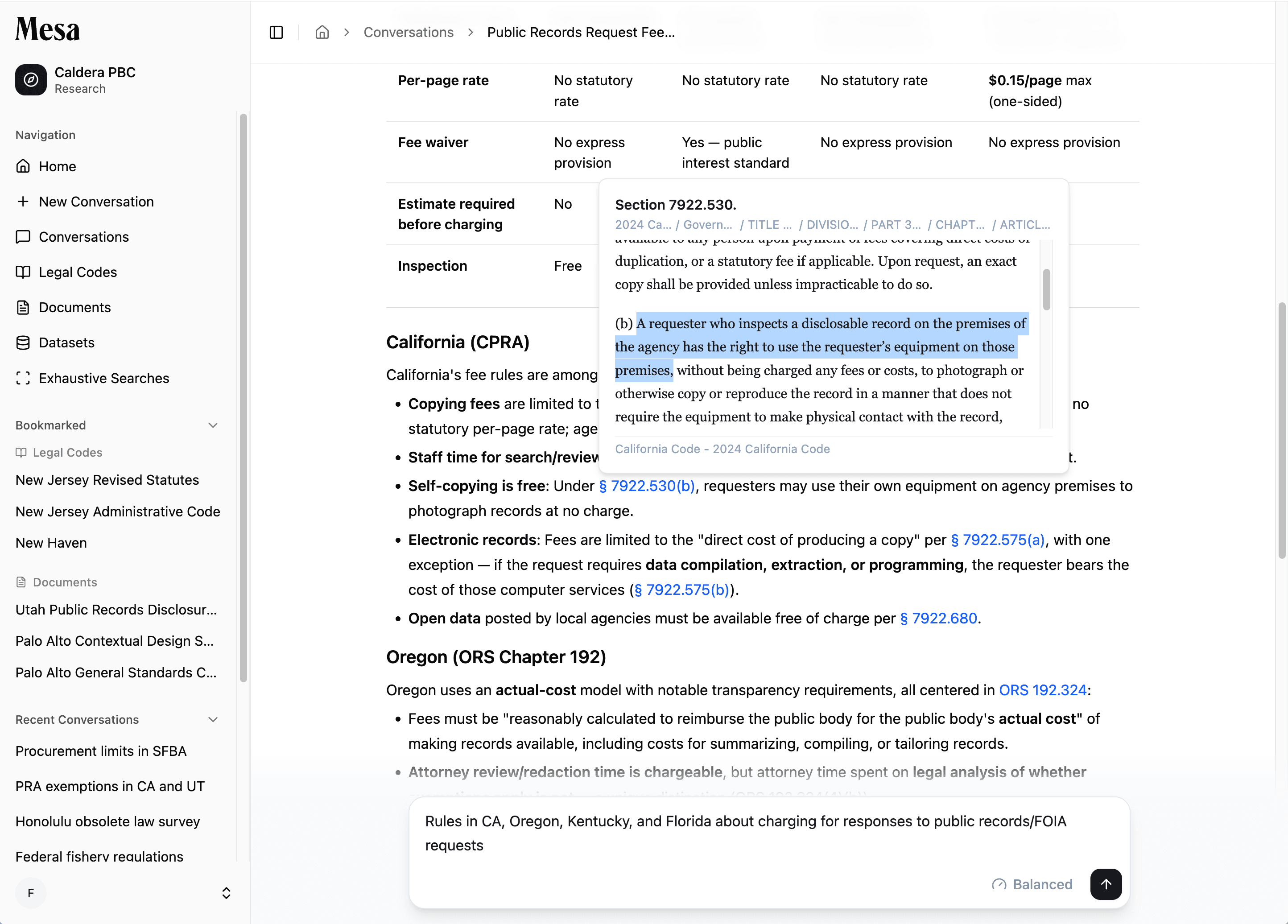
Mesa Research workspace: sidebar with conversations and legal codes, a cited public records comparison across California, Oregon, Kentucky, and Florida, with an inline citation popover open on California Government Code 7922.530

Most answers are already on the books. In state code, in a council resolution, in a GIS layer, in a staff report from four years back. Mesa finds it and cites the line—in seconds or minutes, not quarters.

Ask it the way you’d ask a colleague.

A researcher asks when New York counties must disclose police misconduct records and what exemptions still apply after the 2020 repeal of Civil Rights Law section 50-a. Mesa reads state statutes, case law, and a records retention schedule, collecting six sources: Civil Rights Law section 50-a (repealed), Public Officers Law section 87, sections 87(2)(b) and 87(2)(e), Matter of Patrolmen’s Benevolent Ass’n v. De Blasio (2019), and New York State Records Retention Schedule LGS-1. It answers that since the repeal, counties must release misconduct records on request under FOIL; they may still withhold material that would be an unwarranted invasion of privacy or would interfere with an open investigation or proceeding; and body-camera footage is not a personnel record and is retained under schedule LGS-1. Each statement carries a numbered citation matching its source.
  • Plain-language questions

    Mesa picks the sources, reads them, and answers with citations.

  • Answers you can check

    Every claim links to the provision, page, or passage it came from.

  • Work that carries over

    Conversations persist, so a long project picks up where you or a colleague left off.

Work across the systems your agency runs.

  • GIS and parcel data

    Mesa queries ArcGIS layers directly, so it can tell you which parcels fall inside a zone or an overlay.

  • Council and board records

    Agendas, minutes, and resolutions from Legistar, Granicus, and eScribe, searched alongside the code.

  • Documents and data

    SharePoint, Laserfiche, Google Drive, and open data portals, with your data left where it is.

Check any citation without leaving the answer.

A research answer says the city has 10 days from receipt to determine whether a records request seeks disclosable records, citing California Government Code section 7922.535(a). Hovering the citation opens the verbatim text of subdivision (a), with the ten-day determination clause highlighted and a mark confirming the quote matches the source. Opening it in the code shows its place: Government Code, Title 1, Division 10, Part 3, Chapter 1, Article 2, section 7922.535.
  • See the source

    Hovering a citation shows the passage, with the supporting language highlighted.

  • Open the code

    One click opens the full code at the provision the agent used.

  • Keep the trail

    Each response records the sources the agent consulted, and you can export them.

Put an agent on every piece of a big job.

  • Each piece read closely

    Mesa splits the work by chapter, by state, or by folder, and each agent reads its piece the way a careful analyst would.

  • Progress you can follow

    You can watch pieces finish as the job runs and open any one to see how it got its answer.

  • One result at the end

    Findings come back as a single dataset or report, checked by Mesa before it reaches you.

See what comparable cities actually do.

How do peer cities regulate short-term rentals? A table compares four peer cities on five rules, each cell cited to the code section it came from. Westover: registration required (WMC 5.72.020), primary residence only (5.72.040), 90-night annual cap (5.72.050), $250 fee (5.72.060), $500 daily fine if unregistered (5.72.110). Rivermont: registration required (RMC 8.40.020), primary residence only (8.40.030), 120-night cap (8.40.045), $300 fee (8.40.070), $1,000 daily fine (8.40.120). Fairhaven: registration required (FMC 9.44.020), no primary-residence requirement (9.44.030), 90-night cap (9.44.040), $275 fee (9.44.080), $500 daily fine (9.44.150). Marbrook: registration required (MMC 5.36.010), primary residence only (5.36.030), 120-night cap (5.36.040), $1,100 fee (5.36.050), $750 daily fine (5.36.090). Two cells depart from the peers: Fairhaven has no residency rule, and Marbrook’s fee is four times the peer median.
Cities 1–2 of 4
  • One table, every cell cited

    Peer jurisdictions side by side, each cell linked to the provision it came from.

  • Spot the outliers

    Mesa marks where your rules differ from your peers’, and by how much.

  • Start from precedent

    A first draft can begin from language peer cities have already adopted.

Turn research into a memo you can send.

A City of Westover memo to the Planning Commission, “Short-term rental rules in three peer cities.” Its findings, with footnoted code citations, say two of three peers limit whole-home rentals to the host’s primary residence and Marbrook’s fee is four times the others’, followed by an excerpt of the peer comparison table. The memo is published at a public link that opens without an account, is on revision 7, and is exported to Word and PDF.
  • Revisions

    Every save is a revision you can compare or roll back.

  • Share without seats

    Publish a link that anyone can read without a Mesa account.

  • Word and PDF

    Export with citations and tables intact.

How much Mesa finds.

We asked Mesa and four other AI research tools to find every criminal provision in the U.S. Code. The next-best system found 63 percent of them. Mesa found 99.8 percent.

Finding every federal criminal provision in the U.S. Code

Recall, best of three runs per system

Mesa

99.8%

Leading legal AI startup

63.0%

Claude Research

42.2%

Gemini Deep Research

14.4%

Westlaw AI Jurisdictional Surveys

7.2%
From “What Is the Law? A System for Statutory Research with Large Language Models” (ICAIL 2025). Each system was asked to identify every provision defining a criminal offense in the United States Code. Recall is measured against a validated superset of Count the Code, an independently compiled catalog of about 2,000 federal criminal provisions.

The law for 10,000+ jurisdictions, and your agency’s own systems.

Mesa keeps statutes, codes, regulations, and case law current, and works across them alongside the web, your documents, and systems like ArcGIS and Legistar.

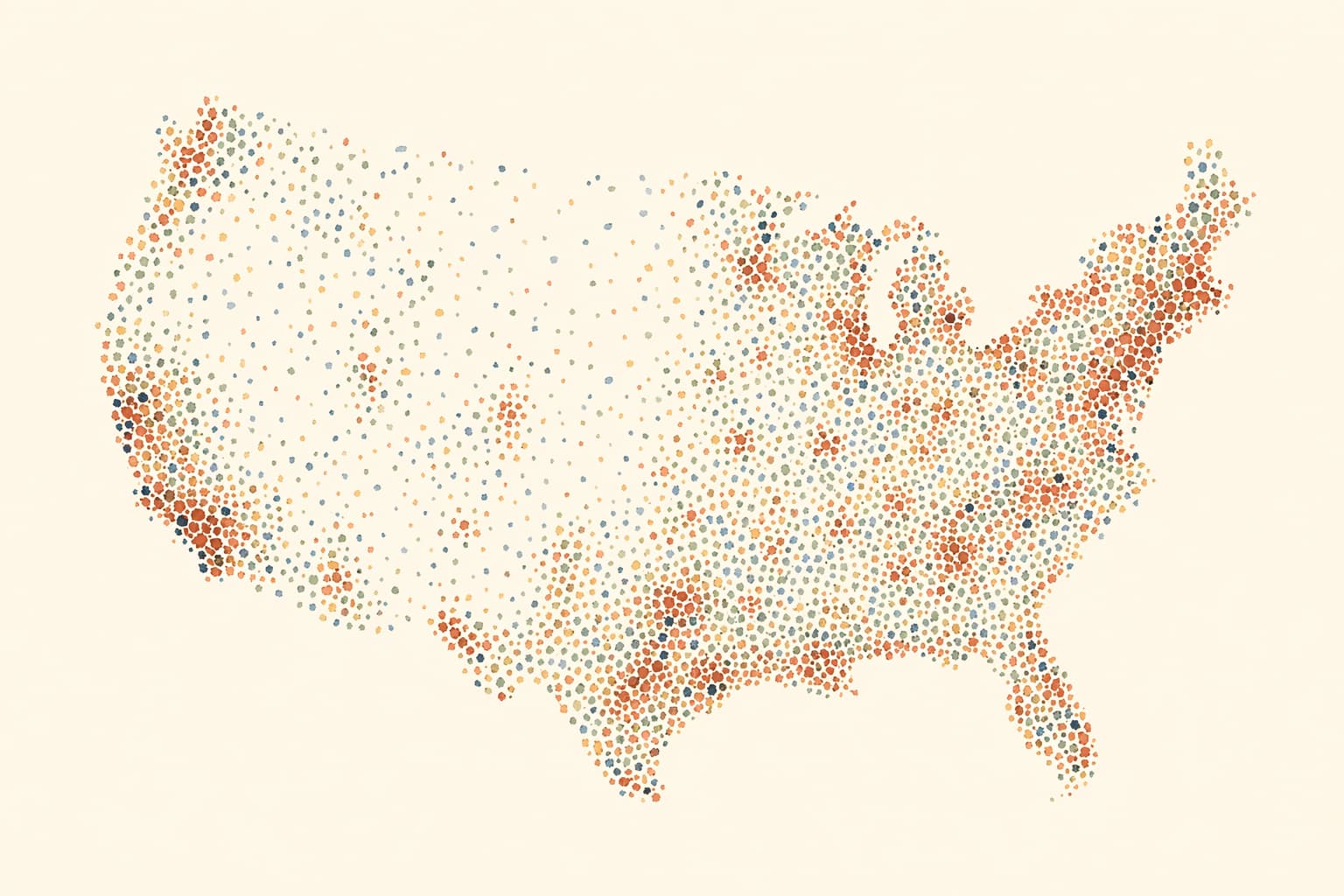
Continental United States suggested by clustered painted dots

Statutes & codes

State statutes, city and county codes, and regulations, kept current and versioned.

Case law

State and federal opinions, linked to the statutes they interpret.

Web search

Agency sites, news, and other public sources, cited like everything else.

Your internal systems

GIS layers, council records, document repositories, and open data, through connectors to ArcGIS, Legistar, Laserfiche, SharePoint, and more.

Connectors

Connects to the systems you already use.

Municode
American Legal
Esri ArcGIS
Laserfiche
Granicus
eScribe
SharePoint
Microsoft 365
Google Drive
YouTube

If yours isn’t listed, .

Bring a question you’re working on.

We’ll run it through Mesa with you and show you what it finds.